Yerevan unfolds slowly, like a city that has learned patience from centuries of endurance. Built on volcanic stone and shaped by repeated cycles of destruction and renewal, Armenia’s capital does not announce itself with spectacle. Instead, it invites attention. The longer you stay, the more its layers begin to surface—through architecture, ritual, conversation, and the quiet weight of memory.
At first glance, Yerevan feels open and sunlit. Broad avenues radiate from central squares. Buildings glow in shades of rose and sand, carved from local tuff stone that shifts color throughout the day. This material continuity gives the city a visual calm, even as traffic moves and cafés fill. Beneath that surface, however, lies one of the world’s oldest continuously inhabited urban landscapes.
History here is not confined to museums. It lives in elevation and orientation. Nearly every clear morning, residents glance instinctively toward the horizon, where Mount Ararat rises beyond the border. Although the mountain now lies outside the country, it remains deeply embedded in Armenian identity. From rooftops, parks, and apartment balconies, Ararat anchors the city to a much older narrative—one of origin, loss, and continuity.
Walking through central Yerevan reveals how time compresses rather than separates eras. Soviet-era residential blocks stand beside early 20th-century civic buildings and modern glass cafés. Republic Square gathers these influences into a single space, where children run through fountains in summer and evening crowds assemble without urgency. The square feels civic rather than monumental. It is used, not staged.
Movement through the city often leads upward. The Cascade Complex, a massive stairway linking downtown with higher neighborhoods, functions as both infrastructure and gathering place. Locals climb slowly, pausing to talk, rest, or look back toward the city grid. From the top, Yerevan appears contained and human in scale. Mountains encircle it gently, reinforcing the sense that the city exists in dialogue with its landscape rather than in defiance of it.
Daily life reinforces this grounded rhythm. Mornings begin with bread. Small bakeries pull lavash from clay ovens, stacking warm sheets against tiled walls. Markets open early. Vendors arrange herbs, dried fruit, and cheeses with practiced efficiency. Conversation flows easily, even across language gaps. Hospitality here is direct and unpolished. It is offered as a norm, not a performance.
Food reflects memory as much as taste. Meals stretch longer than expected. Dishes arrive in layers: fresh vegetables, grilled meats, slow-cooked stews. Wine and brandy appear naturally, often homemade or poured without ceremony. Recipes carry stories of migration and adaptation, shaped by geography and survival rather than trend. Eating in Yerevan feels participatory. You are drawn into continuity rather than novelty.
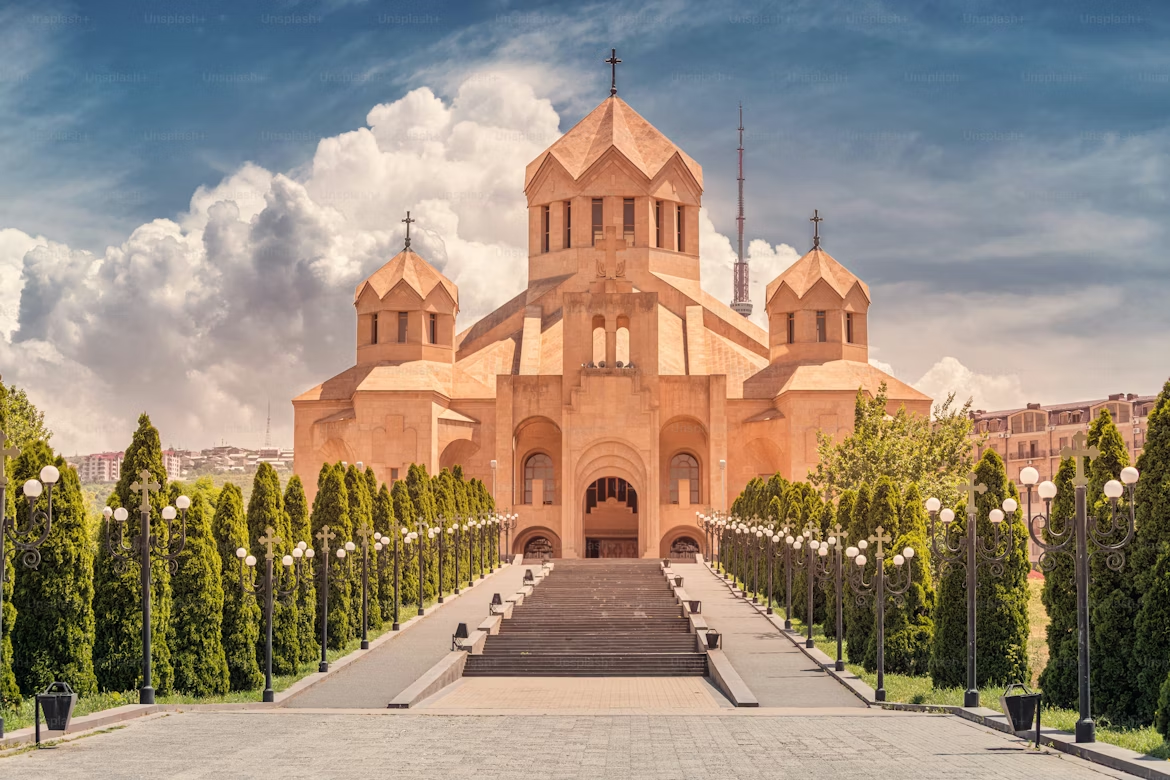
Cultural spaces deepen this sense of time. Manuscripts, stone crosses, and oral traditions speak to a civilization that has preserved itself through language and faith even when borders shifted. Churches appear modest from the outside, built low and solid. Inside, light falls sparingly on worn stone and candle smoke. Silence feels intentional. These are not places of spectacle but of endurance.
Evenings soften the city further. Streets cool. Cafés fill with layered conversations—political, personal, reflective. Music drifts from open windows, sometimes classical, sometimes folk, sometimes improvised. There is little rush to end the day. Time feels elastic, shaped more by social connection than by schedule.
What defines Yerevan as a destination is not a checklist of attractions, but a particular relationship with history. The past is neither romanticized nor hidden. It is present, acknowledged, and carried forward. The city does not attempt to reinvent itself by erasing what came before. Instead, it builds carefully on what remains.
For curious travelers, Yerevan offers depth rather than distraction. It rewards walking, listening, and repetition. Streets become familiar quickly, yet meaning continues to unfold. In this city rooted in time, the journey is not about moving fast through space, but about learning how to stay, observe, and understand.